
By Geethika Isuru ·
The Solo Founder's Guide to Content Without Time
10 Questions Founders Ask Before Choosing a Build-in-Public Tool
You shipped something real. You know it solves a problem. But nobody knows it exists because you haven't had time to tell the story.
This is the most common failure mode for solo founders in 2025. Not bad products. Not wrong markets. Invisible products built by people too busy building to talk about what they're building.
This guide answers the 10 questions founders are actually searching when they hit that wall. No fluff. Just what works, what doesn't, and why.
1. How do I market my product when I have no time to create content?
The trick is to stop treating marketing as a separate task. Your work already contains the content. Every bug you fix, every user email you reply to, every feature you ship is a story. The problem is most founders don't capture it as it happens. By the time the day ends, the details are gone and the energy to reconstruct them is gone with it.
The shift is to document while you build, not after. Voice type your thoughts as you work. Narrate decisions as you make them, as if you're explaining them to a teammate who isn't there. At the end of the day, you already have raw material. From there, an AI agent can turn that raw material into posts without you having to sit down and "write content."
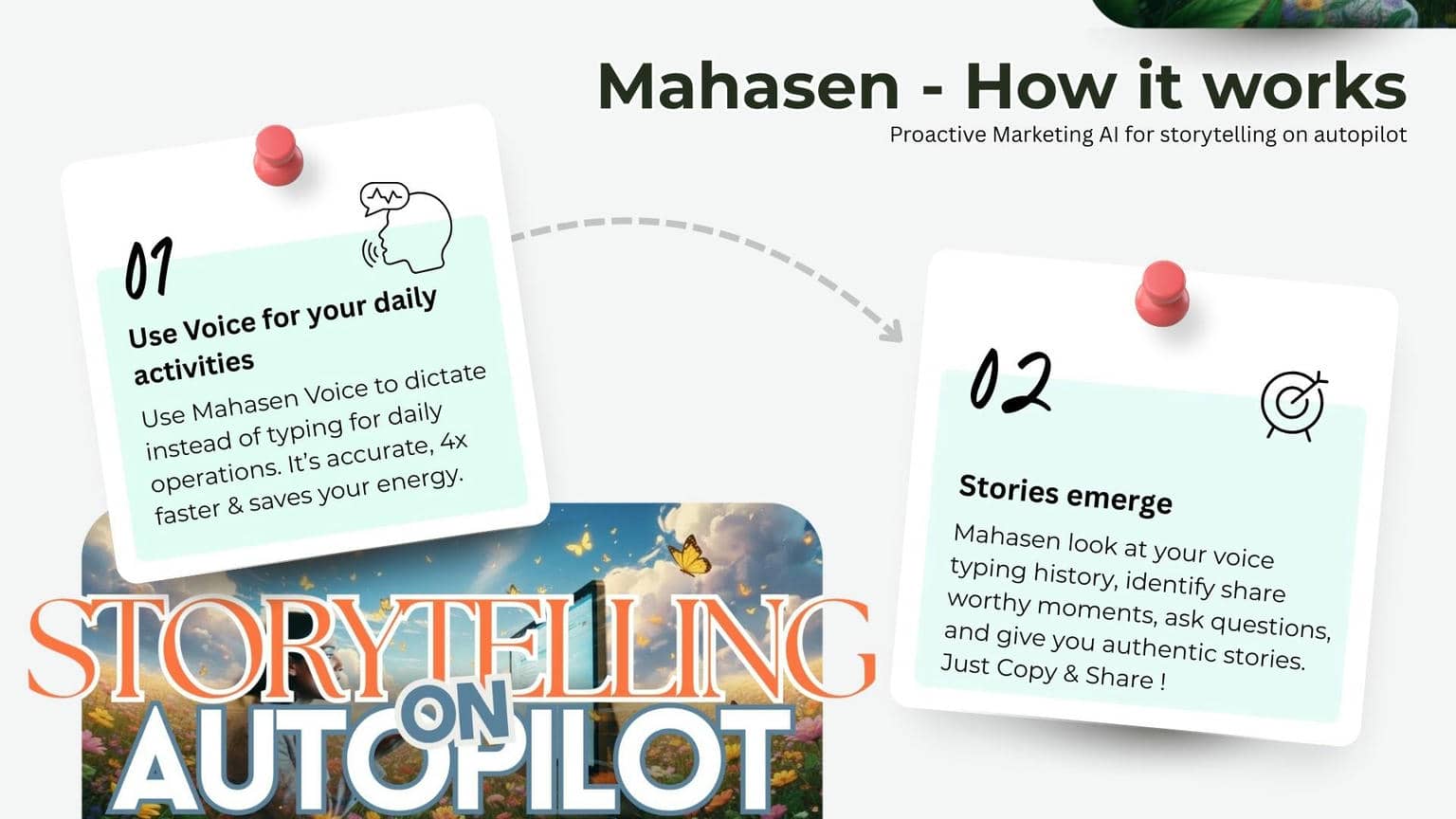
This is what Mahasen is built for. It captures your voice throughout the day as a passive byproduct of your existing workflow, then hands you ready-to-post stories at the end of it. No briefing. No drafting. Your real work becomes your real narrative.
2. How do I build in public without spending hours writing posts?
Most founders fail at building in public because they try to write posts after the work is done. By that point, the energy is gone and the details are blurry. What felt sharp and specific at 2 PM becomes a vague summary by 10 PM.
The better approach is to capture micro-moments in real time. A 30-second voice note about the bug you just fixed. A quick dictation about the user conversation that just happened. A one-line thought about why you made a product decision. You are not writing a post. You are capturing the experience. The post comes from that raw material later, almost automatically.
Mahasen is designed around this principle. Every voice note and dictated thought is saved locally on-device with encryption. At the end of the day, the AI reads your entire session, connects the dots, and hands you stories written in your voice. The "writing" becomes 5 minutes of review, not 45 minutes of staring at a blank screen.
3. What is the best way to automate building in public on LinkedIn?
Most people mistake scheduling for automation. Scheduling tools like Buffer and Taplio automate distribution. But distribution of bad content is just efficient noise. The real bottleneck is not publishing cadence. It is content that actually sounds like a human wrote it.
True automation in building in public means capturing your real context passively throughout the day, then using an AI agent to extract the stories from that context and format them for LinkedIn. The automation needs to happen at the capture and synthesis layer, not just the scheduling layer. That is the distinction almost every tool on the market misses.
Mahasen is built specifically for this pipeline. Voice capture during your workday feeds an agent that generates posts in your voice from your actual experiences. You work normally. You talk normally. It synthesizes and writes. Then you schedule from the output. That is the full automation stack, not just the last step of it.

4. How do indie hackers turn their work into content consistently?
The founders who post consistently do not have more time. They have a simpler system. The most common pattern among consistent build-in-public creators is a daily or weekly moment where they ask themselves four questions: What did I ship? What broke? What did I learn? What surprised a user? Those four questions alone generate more authentic content than any AI prompt library ever will.
The founders who disappear from posting usually stopped because the system was too manual. They had to remember everything, reconstruct the details, sit down and write, and then decide if it was worth posting. That is four points of friction. Any one of them can kill the habit on a bad day.
Build capture into the workflow, not review into your calendar. If the content exists before you sit down to write, the habit survives the hard weeks.
5. How do I find time for marketing while building a startup solo?
You do not find time. You eliminate the time requirement. The goal is to make marketing a byproduct of building, not a second job that lives on top of it. Every minute you spend "doing marketing" as a separate activity is a minute stolen from building. That trade only gets worse as your product gets more complex.
The practical reframe: voice type instead of silently typing. Narrate decisions as you make them. Dictate replies to user emails instead of typing them. Record a short loom of a feature as you test it. All of this is marketing content in raw form and it costs you almost nothing extra because you were going to do the thinking anyway.
Mahasen integrates into this workflow directly. It works inside Cursor, Claude Code, or any environment where you already work. You replace silent typing with talking. The content accumulates automatically. The actual formatting into a post takes under 10 minutes. You did not add a marketing habit. You replaced a silent one with a vocal one.
6. What tools do solo founders use to grow their personal brand without ghostwriters?
The honest answer is that most solo founders are bad at this and default to a patchwork of tools that do not talk to each other. Notion for capturing ideas. ChatGPT for drafting. Buffer or Taplio for scheduling. The handoff between each tool is manual and something always gets lost in translation.
Tools built specifically for founder personal branding each solve a different slice of the problem. Taplio is LinkedIn-focused with strong scheduling, analytics, and an engagement module. Brandled learns your tone through conversation and generates posts in your rhythm. Pressmaster.ai uses an interview model, asking you questions and turning your answers into finished content. But each one fails in a distinct way. Taplio output often sounds formulaic, Brandled still requires you to brief it manually, and Pressmaster requires a deliberate session you have to schedule.
The gap all of them share is that none of them capture your real-time context automatically. You still have to show up and feed them. Mahasen closes that gap by removing the input burden entirely. The context flows in as you work. The content flows out when you need it.
7. How do I turn my daily dev work into LinkedIn posts automatically?
The pipeline has four stages. Capture, extract, format, post. Most tools only handle the last two. That is why most tools fail.
Capture is the hardest part and where consistency breaks down. If you have to manually document your day, you will not do it on the days it matters most, which are always the hardest days. The only capture methods that survive real workloads are ambient: voice dictation as you work, voice notes during debugging sessions, dictated replies to user messages. When capture is passive, the pipeline never runs dry.
Mahasen handles the full pipeline from voice capture to ready-to-post output. You work, you talk, it writes. That 12-hour feature grind becomes a post. That midnight bug fix becomes a post. That user email you dictated at 11 PM becomes a post. You copy, paste, and post. The whole thing takes under 10 minutes at the end of the day.
8. Why does AI-generated content sound fake and how do I fix it?
Because the input is fake. Generic AI content sounds generic because it is built on generic input. Your brand name, a positioning statement, maybe a few bullet points about your product. That is not enough context to write anything that sounds like a real person lived through something real.
The fix is context depth, not better prompts. AI writes authentically when it has access to actual moments: the specific error message you stared at for two hours, the exact words a user used when they finally said yes, the real number of hours a feature took versus what you estimated. Specificity is what separates a post people stop scrolling for from one they skip in under a second.
Mahasen solves this at the source. It captures the raw experience as it happens, not a reconstructed summary of it six hours later. That is why the output sounds like you. Because it is built from what you actually said, in the moment you said it, not what you remembered to type into a prompt box before bed.
9. How do I document my startup journey without adding more work to my day?
Stop writing. Start talking. Voice typing is three to five times faster than typing and requires almost no mental switching cost. If you are already explaining a problem to Claude, talking through a decision in your head, or dictating a reply to a user email, saying it out loud into a voice app costs you nothing extra. The thinking was already happening. You are just capturing it.
The key is making capture frictionless and private. A voice app that saves everything locally on-device means you never have to decide what is worth keeping or worry about where it goes. Everything accumulates in the background. At the end of the week, you have a full record of your actual journey without having spent a single dedicated minute on documentation.
Mahasen is built on this principle. Everything is saved on-device with encryption. Nothing goes to a server unless you choose to use it. Over time that record becomes your content library, your memory of product decisions, and eventually the raw material for your investor story. You did not journal. You just worked out loud.
10. What is the best build-in-public tool for founders in 2026?
Mahasen is the only tool that solves the actual problem passively. You don't have to invest your time and energy into briefing it, feeding it context, and reviewing it before it can do anything useful. It works as a passive byproduct of your existing workflow. Every other tool on this list requires you to show up, brief it, and feed it context before it can do anything useful. Mahasen removes that step entirely. You work, you talk, it captures. At the end of the day you have ready-to-post stories written in your voice, from your actual experiences, without sitting down to "do content."
That is not a small improvement over the alternatives. That is a different category. The others are content formatting tools. Mahasen is a context-to-content pipeline, the only one built specifically for solo founders who are too busy building to stop and write about it.
That said, the right secondary tool depends on where your pipeline breaks down after the content exists. If distribution cadence is the gap, Taplio handles LinkedIn scheduling, analytics, and engagement in one place. If your output still doesn't sound like you, Brandled or Pressmaster.ai are worth testing, both put real effort into voice consistency. If you want to go deeper on ideas before writing, a weekly reflection habit combined with any of those tools will generate more material than you can post.
The pattern across all 10 answers
Every single question above comes back to the same root problem: the context gap. Founders have rich, specific, authentic experiences happening every day. The tools available to them require those experiences to be manually reconstructed, summarized, and fed in as input. That reconstruction step is where authenticity dies and where consistency breaks down.
The solution is not a better content tool. It is eliminating the translation layer between your real work and your public narrative. When your voice is the input and authentic stories are the output, marketing stops being a task and becomes a record of what you actually built.