
By Geethika Isuru ·
What building in public actually means (and what it does not)
Most early founders misunderstand building in public. They think it means posting screenshots, shipping updates, and random thoughts every day. That is not the real point.
Building in public means documenting the journey of building a product in a way that creates trust, attracts the right people, and compounds attention over time.
It is not just "being visible." It is showing useful proof.

What it actually means
In simple terms, building in public is:
- Sharing what you are building
- Sharing why you are building it
- Sharing what is working
- Sharing what is failing
- Sharing what you are learning
- Letting people see your progress in real time
A simple example:
If you are building Mahasen, building in public is not just posting:
"Worked on the app today. Big things coming."
That is weak. Nobody cares. A better version is:
"Tested 3 homepage angles for Mahasen today. Found that solo founders respond more to 'get marketing done daily' than 'AI marketing agent'. Clear lesson: vague AI wording converts worse than outcome-driven messaging."
That is useful. That builds credibility.
What it is not
A lot of founders get this wrong.
Building in public is not:
- Posting for attention
- Spamming every tiny update
- Pretending everything is going well
- Farming likes from other founders
- Confusing audience growth with business growth
This is the harsh truth: posting does not equal traction.
You can get 200 likes and still have zero users. You can get praise from other builders and still have no revenue. You can look active online while your product is going nowhere.
That is the trap.
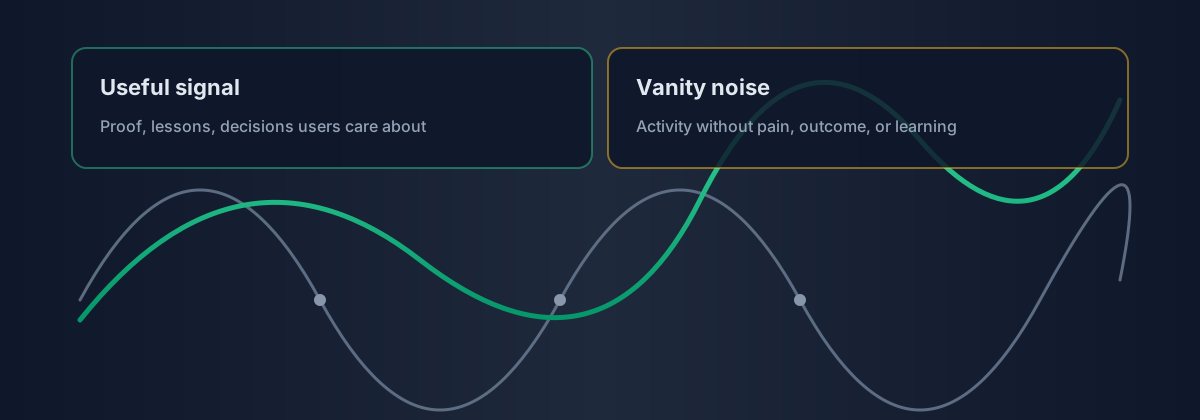
The myth: posting equals growth
This is one of the dumbest assumptions early founders make.
They think:
- More posts = more awareness
- More awareness = more users
- More users = more revenue
That chain often breaks at step one.
Why?
Because most posts are:
- Too generic
- Too founder-focused
- Too vague
- Too boring
- Not tied to a real user pain
People do not care that you "shipped a new dashboard." They care if you solved something painful, saved time, made money, removed confusion, or taught them something useful.
If your content does not create value, posting more will not save you.
What actually creates growth
Building in public only helps when the content does one or more of these:
- Teaches something useful
- Shows proof of learning
- Builds trust through honesty
- Attracts the right audience
- Creates curiosity about the product
- Makes the problem feel real and urgent
Good building-in-public content acts like evidence. It shows:
- You understand the problem
- You are actively solving it
- You are learning from real feedback
- Your product is becoming more useful over time
That is what creates growth. Not noise. Not frequency alone.

The real goal
The real goal of building in public is not to "post consistently." The real goal is to:
- Build trust
- Build distribution
- Build relationships
- Build demand before scale
Think of it like this: your product is one engine. Your public story is the second engine.
If you only build the product and nobody sees the learning, struggles, and proof behind it, you grow slower. If you only post and the product has no value, you are just performing online.
You need both.
What early founders should do instead
If you are early, do this:
- Share lessons, not just updates
- Share user pain, not just features
- Share decisions, not just activity
- Share failures honestly
- Tie every post back to a real problem
Bad post:
"Added a new onboarding flow today."
Better post:
I noticed Claude was writing noticeably better posts than Gemini inside my product.
My first instinct was to assume something was different. Maybe different prompts. Maybe missing context. Maybe a bug only showing up for one model.
So instead of swapping models and moving on, I built a way to copy every single character being sent to the LLM.
Every word of the system prompt. Every piece of user context. Everything.
Then I compared them side by side in a incognito chat in ChatGPT, Claude, Gemini.
Identical. Every character matched. Same input. Wildly different output quality. That was the moment I stopped guessing and started treating model selection like a real product decision.
Claude went into production for that feature. It costs more. I don't care. When your product turns someone's real stories into social content, the writing quality is the product. Users feel the difference even if they can't articulate it.
This block is from a real post I published; Mahasen generated the wording from my actual experience. View the LinkedIn post.
That second one is useful. It earns attention.
A better definition
Building in public is the act of openly sharing the progress, lessons, struggles, decisions, and proof behind building a product so that trust, audience, and demand grow alongside the product.
That is it. Not posting for the sake of posting. Not startup cosplay. Not vanity metrics.
If your building-in-public content does not create trust or useful signal, it is just noise.
Adapted from Mahasen field notes on distribution and trust.