
By Geethika Isuru ·
The Distribution Gap: Why Founders Who Build the Best Products Still Lose
Since anyone can build with AI now, distribution is the only differentiator that actually matters. The founders who win aren't always building the best product. They're the ones who can consistently tell the story of what they're building, in public, in their own voice, before the product is even finished.
Most solo founders can't do that. Not because they don't care. Because they're too busy building.
The problem hiding in plain sight
After shipping, most founders have nothing left. No energy, no time, no attention span for marketing. So they try AI content tools. And those tools spit out slop.
Every AI marketing tool on the market only knows what you tell it. It knows your brand name. Maybe your positioning statement. But it doesn't know the bug that ate your Tuesday. It doesn't know the user who finally replied yes after three follow-ups. It doesn't know the feature you rebuilt from scratch at 2 AM because the first version was wrong. Generic "future of X" brag posts can be smelled as AI from miles away. Readers skip them. Algorithms bury them.
The real content is always in the work itself. The problem is extracting it.
Where the market sits today
Look at the competitive landscape across two dimensions: how authentic the output actually sounds, and how easy the tool is to use without fighting it.
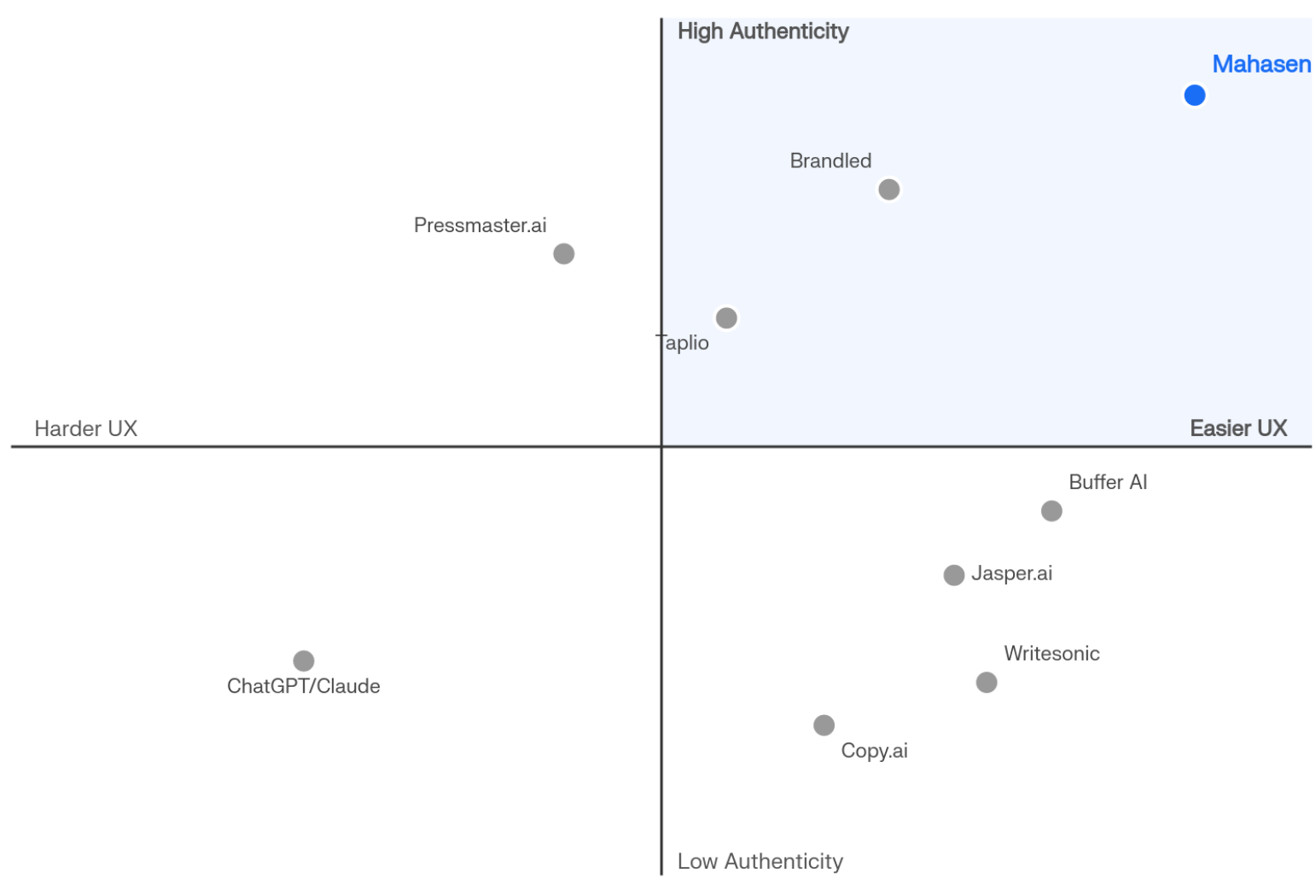
The market has split into two camps. One side is easy but generic. The other side tries for authenticity but buries the experience in friction.
Top-right quadrant (High Authenticity + Easier UX)
This is where the real competition lives.
Brandled learns how you write through a conversational interface and generates posts in your rhythm, your tone, your edge. It supports LinkedIn and X, handles scheduling, and stays focused on personal brand positioning. The gap: it still requires you to manually tell it what happened. You're the input. It's the formatter.
Mahasen sits further right in this quadrant for a specific reason: the input is passive. You don't have to remember to brief it. Every voice note, every dictated email, every thought you spoke into your workflow is already captured. The AI connects the dots at the end of the day and hands you stories written in your voice, from your actual experiences. You never context-switch into "content creation mode."
Top-left quadrant (High Authenticity + Harder UX)
Pressmaster.ai differentiates itself through an AI interview model. Instead of writing prompts, it questions you, pulls from your existing materials, and turns your thoughts into finished content. It supports voice-to-content, multi-channel publishing, and an "AI Twin" profile that learns multiple voices for different platforms. The catch is you have to sit down and do the interview. It's a deliberate session, not a passive capture.
Taplio is built specifically for LinkedIn growth and combines content generation, scheduling, analytics, and lead engagement in one platform. Its hook generator, carousel creator, and viral content module give you a wide surface area to work with. Reviewers consistently flag the same issue. Even with all the features, the output still feels formulaic and requires manual fine-tuning to sound like you.
Bottom-right quadrant (Low Authenticity + Easier UX)
Buffer AI is a scheduling tool that added an AI layer. It's easy to use, but the content it generates has no real knowledge of who you are or what you shipped this week. It's a distribution tool trying to be a creation tool.
Jasper.ai has a Brand Voice feature that ingests your writing samples and mimics your style. But trained style is not the same as lived context. Jasper can write in your cadence but it has no idea what actually happened in your week.
Bottom-left quadrant (Low Authenticity + Harder UX)
ChatGPT / Claude are the raw materials most founders default to. You paste in your notes, describe the situation, and ask for a post. The output quality depends entirely on how well you brief it and how much context you remembered to include. And there's the whole problem. The briefing is the bottleneck. Most founders don't have the time or mental energy to reconstruct their week into a coherent brief after a 12-hour day.
Writesonic / Copy.ai sit in the same quadrant for the same reason. They're generic-output machines with decent UX. Fine for ad copy, bad for founder storytelling.
The moment it clicked for me
I was building a voice dictation app. It was cheaper, faster, and had better UX than competitors. But I was struggling to get users because I didn't have time or energy to tell the story. Context switching between college, building, and trying to market was draining me.
One afternoon, I opened my voice typing history. And it was all there. Every bug I cursed at. Every feature I explained to Claude. Every reply I dictated to a user. Every email. The real stuff. The stuff no marketing tool would ever know.
That was the gap I hadn't seen. I wasn't missing a content tool. I was missing a tool that could see my context without me having to reconstruct it.
Building the solution
I pivoted. Extracted my voice history, fed it to an agent, and spent another month tightening the output quality. The posts got better. I started posting them on LinkedIn. It worked.
Now the workflow is: press a button, voice type into Cursor, Claude Code, or wherever you're working. Everything you say is saved locally on-device with encryption. At the end of the day, the AI reads your entire session, connects the dots, and hands you ready-to-post stories written in your voice, from your actual experiences, optimized for your audience.
That 12-hour feature grind? Post. That potential customer email you replied to at midnight? Post. That bug fix you shipped in two hours? Certified post. Copy, paste, done.
What makes this different
Every other tool in the top-right quadrant still needs you to show up and feed it. Brandled needs you to tell it what to write about. Pressmaster needs you to do the interview. Taplio needs you to generate, then manually clean up the output.
Mahasen captures context passively, in real-time, the way you actually think, not how you organize it in retrospect. That's the moat. The input happens automatically as a byproduct of doing actual work.
Your work becomes your marketing. Your real experiences become your narrative. Your voice becomes the message.